Clarinet Finger Chart
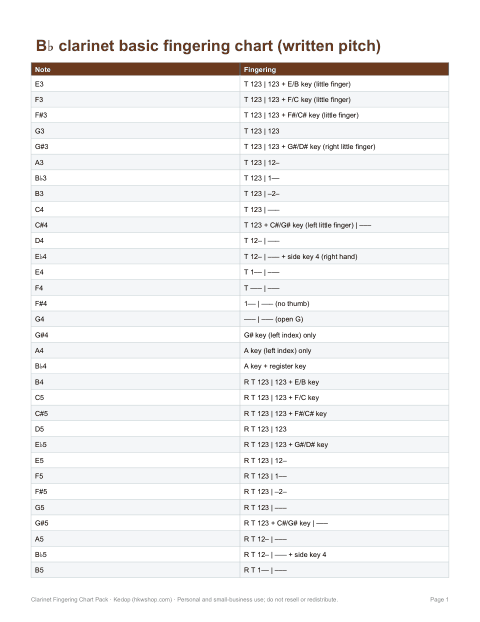
This clarinet finger chart gives the standard fingering for every written note from low E3 up to G6 on a Boehm-system B♭ clarinet, in a clear, printable format. Look up a note below, then download the illustrated chart pack with a key diagram, register-by-register charts and practice worksheets for beginners.
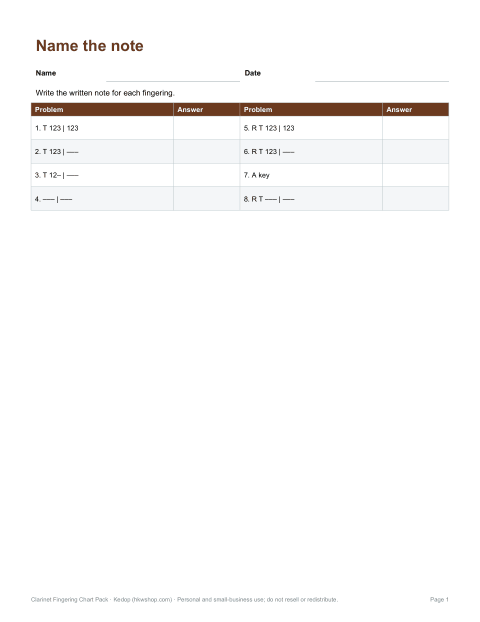
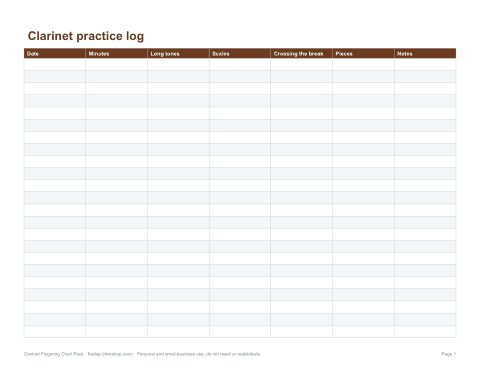
Clarinet Fingering Chart Pack
Printable clarinet fingering charts: full basic fingering chart (written E3–G6), chalumeau, throat/clarion and altissimo pages, a chromatic scale chart, fingering quizzes with answers and a practice log.
- Full chart (PDF/XLSX)
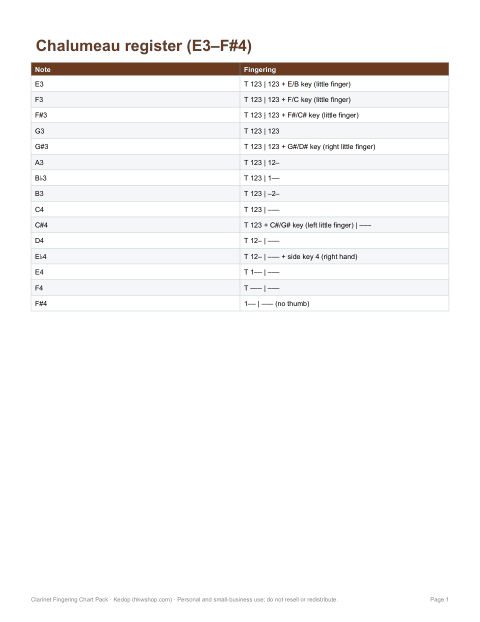
- Chalumeau (PDF)
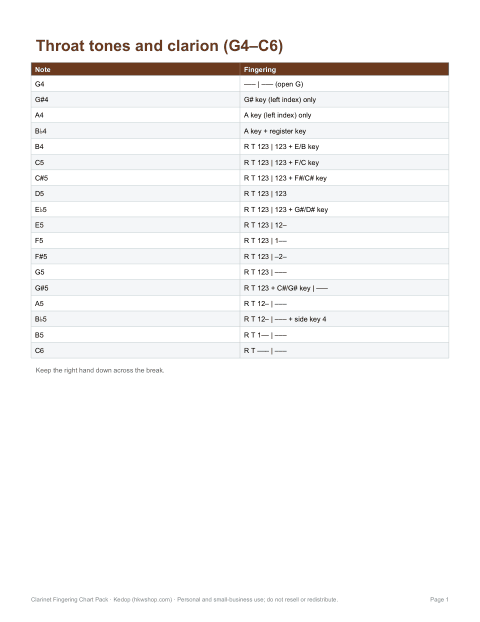
- Throat & clarion (PDF)
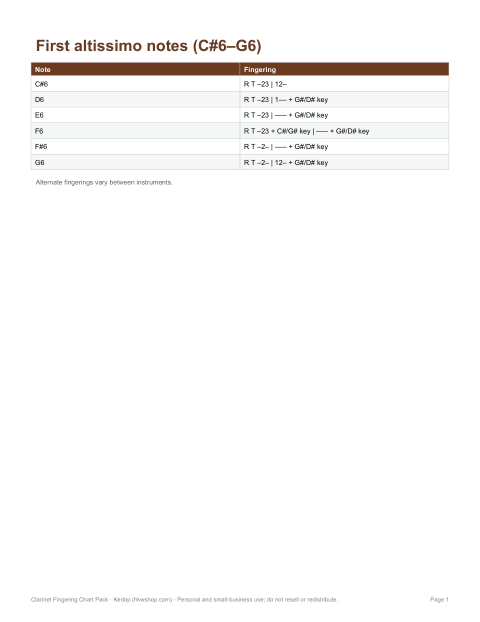
- Altissimo (PDF)
- Fingering quiz (PDF, DOCX)
- Practice log (PDF, XLSX)
Formats: PDF, XLSX, DOCX. Instant download after payment (link valid 72 hours, up to 5 downloads). AI-assisted: the templates were drafted with AI help and reviewed and laid out by Kedop.
$5.00 USD, one-time
Secure card checkout by Stripe. Full refund within 7 days — see the refund policy and license.
Clarinet fingering lookup
Key to symbols: R = register key, T = left thumb hole, then left-hand fingers 1 2 3 | right-hand fingers 1 2 3; “–” = open. Pitches are written for B♭ clarinet (they sound a whole step lower).
Clarinet fingering chart
| Written note | Fingering (R = register key, T = thumb, left 123 | right 123) |
|---|---|
| E3 | T 123 | 123 + E/B key (little finger) |
| F3 | T 123 | 123 + F/C key (little finger) |
| F#3 | T 123 | 123 + F#/C# key (little finger) |
| G3 | T 123 | 123 |
| G#3 | T 123 | 123 + G#/D# key (right little finger) |
| A3 | T 123 | 12– |
| B♭3 | T 123 | 1–– |
| B3 | T 123 | –2– |
| C4 | T 123 | ––– |
| C#4 | T 123 + C#/G# key (left little finger) | ––– |
| D4 | T 12– | ––– |
| E♭4 | T 12– | ––– + side key 4 (right hand) |
| E4 | T 1–– | ––– |
| F4 | T ––– | ––– |
| F#4 | 1–– | ––– (no thumb) |
| G4 | ––– | ––– (open G) |
| G#4 | G# key (left index) only |
| A4 | A key (left index) only |
| B♭4 | A key + register key |
| B4 | R T 123 | 123 + E/B key |
| C5 | R T 123 | 123 + F/C key |
| C#5 | R T 123 | 123 + F#/C# key |
| D5 | R T 123 | 123 |
| E♭5 | R T 123 | 123 + G#/D# key |
| E5 | R T 123 | 12– |
| F5 | R T 123 | 1–– |
| F#5 | R T 123 | –2– |
| G5 | R T 123 | ––– |
| G#5 | R T 123 + C#/G# key | ––– |
| A5 | R T 12– | ––– |
| B♭5 | R T 12– | ––– + side key 4 |
| B5 | R T 1–– | ––– |
| C6 | R T ––– | ––– |
| C#6 | R T –23 | 12– |
| D6 | R T –23 | 1–– + G#/D# key |
| E6 | R T –23 | ––– + G#/D# key |
| F6 | R T –23 + C#/G# key | ––– + G#/D# key |
| F#6 | R T –2– | ––– + G#/D# key |
| G6 | R T –2– | 12– + G#/D# key |
These are the basic (standard) fingerings on a Boehm-system clarinet, as documented by standard references such as the Woodwind Fingering Guide. Many notes have alternate fingerings for smoother technique or tuning; your teacher may suggest others. Little-finger keys for E/B, F/C and F#/C# are duplicated on both hands on most clarinets — alternate hands so you never slide one little finger between keys.
The registers of the clarinet
| Register | Written range | Notes |
|---|---|---|
| Chalumeau | E3 – F#4 | Rich, dark low notes; fingers and thumb cover holes |
| Throat tones | G4 – B♭4 | Open G, then the G# and A keys; can sound thin |
| Clarion | B4 – C6 | Add the register key: the same fingers as a twelfth lower |
| Altissimo | C#6 and above | Special fingerings, often with the left index finger lifted |
The clarinet overblows at the twelfth, not the octave: pressing the register key with the same fingering as low E3 gives B4, a twelfth higher. That is why clarion fingerings match chalumeau fingerings but with different note names.
Understanding the notation
- T — the left thumb covers the thumb hole on the back.
- R — the left thumb also presses the register key (speaker key) above the hole.
- 1 2 3 before the bar — left index, middle and ring fingers covering their holes.
- 1 2 3 after the bar — right index, middle and ring fingers.
- – means that finger is lifted (hole open).
- Named keys (A key, G# key, E/B key, side key 4) are pressed in addition.
Crossing the break
The “break” is the jump from the throat tones (around B♭4) to the clarion (B4 and above), where almost every finger goes down at once. Practise slurring G4 to D5 with the right hand already covering its holes while you play the throat notes — many teachers call this “right hand down” — so only the register key and left fingers need to move. Keep a firm, steady air stream and don’t pinch.
Transposition
The B♭ clarinet is a transposing instrument: written C sounds as concert B♭, a major second lower. The chart and lookup use written pitch, which is what appears in clarinet music. The lookup also shows the concert pitch so you can match a piano or tuner.
Worked example
A beginner reading written C5 finds “R T 123 | 123 + F/C key”: thumb over the hole and on the register key, all six fingers down, and the F/C key with a little finger. Without the register key the same fingering gives F3, a twelfth lower — a useful check that the fingers are sealing properly.
Tips for clean notes
- Cover holes with the pads of your fingers, not the tips.
- Keep fingers close to the holes when lifted.
- If low notes squeak, a finger is probably not sealing a hole.
- Check the reed and ligature before blaming the fingering.
- Use a tuner: throat tones often run sharp and some clarion notes flat.
What the printable pack includes
An illustrated key diagram, register-by-register fingering charts (chalumeau, throat and clarion, altissimo), a chromatic scale chart, fingering quiz worksheets with answers, and a practice log. AI-assisted: the text was drafted with AI help and the fingerings checked against standard references by Kedop.
Frequently asked questions
What is the fingering for low G on clarinet?
Thumb hole plus all six fingers: T 123 | 123.
What is open G?
Written G4, played with no fingers down.
What does the register key do?
It raises notes by a twelfth, taking you from the chalumeau to the clarion register.
Why are there two E/B keys?
So you can alternate little fingers for smooth passages.
Are these fingerings for B♭ or A clarinet?
Both use the same fingerings; the chart uses written pitch.
What is the break on clarinet?
The change from the throat tones to the clarion register, around B♭4 to B4.